
Crawford County Criminal Docket Searches
Three search routes exist. The Crawford Clerk's Case Search link opens Icon Case Management. The public screen is a login gate. It takes a UserID, password, and CAPTCHA. Georgia's E-Access directory routes Crawford to PeachCourt. For Superior documents, that is the path, with a free account advertised and document access that may involve purchase. The Clerk also posts static criminal calendars. A blank Icon screen does not show that a criminal case is missing.
Let the court and case type pick the route. A felony indictment, accusation, or Superior criminal pleading starts with Ryan Johnson's Clerk of Superior Court. Warrants, first appearances, bonds, and preliminary-hearing questions may belong to the Magistrate clerk. Roberta ordinance or traffic matters belong to the municipal clerk. Juvenile delinquency and juvenile traffic questions go to the Juvenile division, which may require authorization.
- Collect the caption, party name, case number if known, and approximate filing year.
- Open the Crawford Icon Case Management route and note that login is required on the observed screen.
- Use the Georgia E-Access directory and PeachCourt for the Superior document route.
- Check the Clerk's criminal status, motion, and trial-week PDFs for a public setting slice.
- Call or visit the relevant clerk when a date conflicts, a result is restricted, or an official copy is needed.
Crawford Criminal Case Numbers
Local numbers follow a simple pattern. The August 28, 2026 criminal status conference sample shows a year prefix, the letters CW, and a sequence. An anonymized illustration is 26-CW-###. It is a format description only. Icon or PeachCourt may not use the same spacing.
Keep the number with the case style and the court. The sample caption reads “STATE OF GEORGIA v. [party],” then lists a count and offense title. A number is only a locator. It cannot tell you whether a charge ended in a conviction, dismissal, plea, or another disposition. If a search returns nothing, check the court level first. Then ask the Clerk whether an older or restricted file needs a different request.
- Count
- An individual charge listed inside a criminal case.
- Felony or misdemeanor
- The classification printed on the criminal calendar when present.
- Bond
- A security or financial field that can appear with a bondsman and bond amount.
- Disposition
- The outcome or status of the case, which a calendar slice may not show.
Criminal Dockets: What They Show
Crawford's Criminal Division files both misdemeanor and felony cases. The filings include citations, accusations, indictments, and pleadings. The division also processes bond forfeitures and Grand Jury Presentments, and it reports traffic, GCIC, and prisoner information to the Department of Corrections. According to the Clerk, Superior criminal cases, pleadings, warrants, and jury lists are all scanned. Even so, viewing an image may take a login. It may take an account, a purchase, or a clerk request.
| Case number | Year-prefix criminal format described in the sample as 26-CW-###. |
|---|---|
| Style of case | Caption structure such as State of Georgia v. a named party. |
| Calendar title | For example, Criminal Status Conference Calendar or a criminal motion or trial-week label. |
| Count and offense | Individual charge number and offense title, with felony or misdemeanor classification when shown. |
| Attorney | Representation field, including a prosecution-side label in the inspected sample. |
| Bond fields | Bondsman and Bond Amt may appear when the calendar includes that information. |
| Disposition | Not a guaranteed field on a calendar PDF; use the register or filed record for the final result. |
A criminal calendar is a map to a hearing. It is not an arrest report or a full case file. A count is not a finding of guilt. A bond amount is not a sentence. A status conference is not a trial, and those distinctions matter when you compare a calendar entry with a later order or disposition.
Reading Crawford Criminal Calendar Fields
The published criminal sample opens with a header. It lists the case number, style of case, calendar title, date and time, presiding judge, and printed date. Each entry can add a count number, offense, classification, attorney, bondsman, and bond amount. The PDF runs to a second page. That is a reminder to read the whole document instead of stopping at the first screen or first row.
Field order helps separate events from outcomes. A criminal status conference is a case-management event. A motion calendar groups arguments or requests. A trial week is a block of days, and it does not mean every listed case will be tried every day. The 2026 schedule lists arraignment, calendar call, and plea, pretrial, and motion dates separately.
The official criminal status conference sample shows the field layout without leaning on private case details.
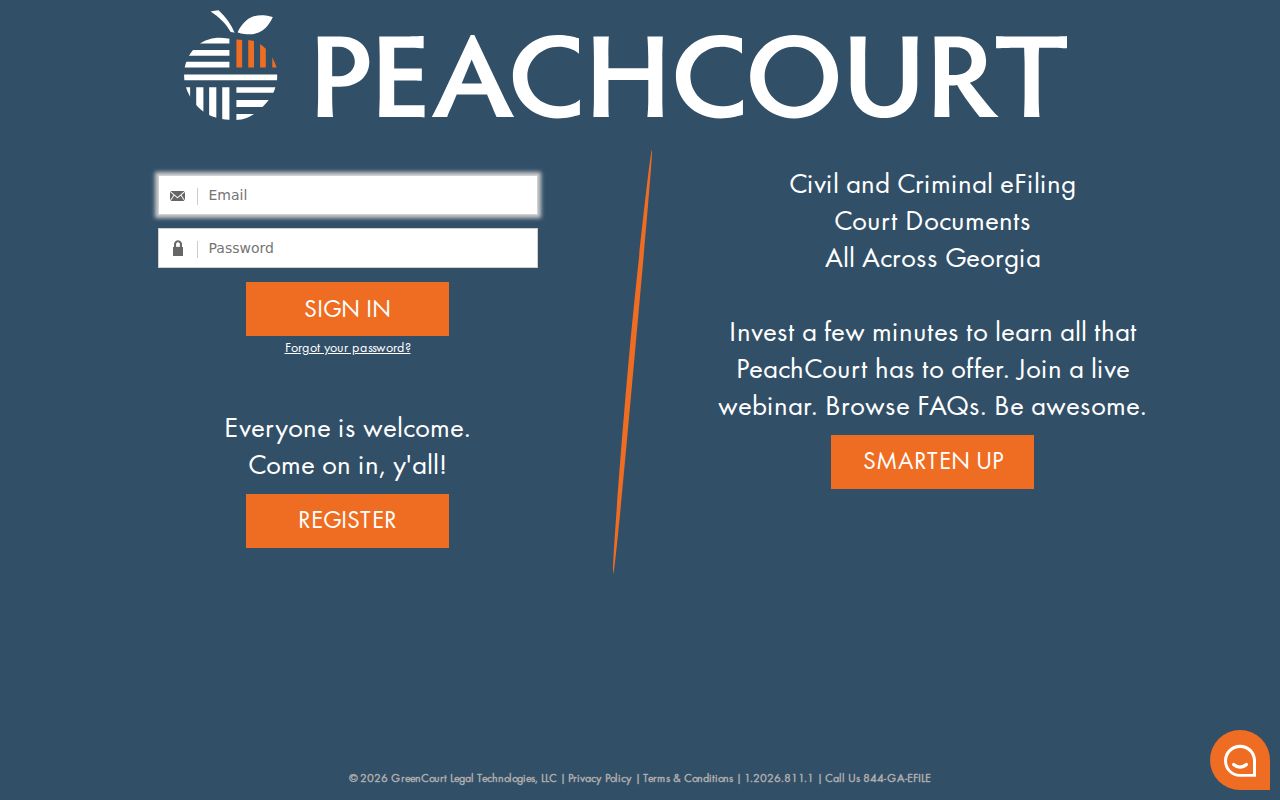
The PeachCourt access screen tells the story plainly. Scanned Superior pleadings and public calendar rows can still stop at an account step before any document opens.
Crawford County Criminal Documents
The Criminal Division says all court pleadings, Superior criminal cases, warrants, and jury lists are scanned. That gives the Clerk an electronic file base. Scanning does not make every image anonymously viewable, though. The Icon screen stays login-gated, and PeachCourt uses an account-based document route.
When a row is not enough, name the document. It might be an indictment, accusation, motion, order, judgment, or something else. Use PeachCourt for the account and document path. The Clerk's counter or phone serves older or restricted files. The certified-copy form covers endorsed, sealed copies. The public calendar remains a settings slice, not a full document list.
Criminal Case Stages on the Docket
A criminal case can pass through several settings. The path is not a promise that every Crawford case follows every step, or that the dates land in the same order. But the path gives the calendar labels meaning.
Filing → Arraignment → Pretrial → Plea or Trial → Disposition → Sentencing
The opening "filing" entry could be several things. On a Crawford County criminal docket, it might be a citation, an accusation, an indictment, or a pleading. It depends on the case. Arraignment and calendar call each get their own line on the 2026 schedule. Some published dates lump plea, pretrial, and motions into one combined label. A disposition entry records an outcome or a status. Sentencing follows later only when the case calls for it. Between any two stages, the docket may show a continuation or a fresh setting.
Crawford County Criminal Docket Courts
Criminal work in Crawford County is divided among several courts. Superior Court takes felony matters and Superior criminal pleadings from the start. Magistrate Court covers warrants, first appearances, bonds, and preliminary hearings. Bad-check cases sit there too. The county also lists its county-ordinance misdemeanors there. City traffic and ordinance violations stay with Roberta Municipal Court. Juvenile Court keeps its own delinquency and juvenile-traffic records.
| Criminal route | Typical docket material | First contact |
|---|---|---|
| Superior Clerk | Felony indictment, accusation, pleadings, bond forfeiture, Grand Jury Presentment | Ryan Johnson, Icon, PeachCourt, or criminal calendar PDF |
| Magistrate Court | Warrant, first appearance, bond, preliminary hearing, listed misdemeanor | Tamela Saffold or Crystal Walker |
| Juvenile Court | Delinquency, unruly, CHINS, deprivation, juvenile traffic | Juvenile division or Clerk, subject to access rules |
| Roberta Municipal | City traffic and ordinance citation | Kim Anglin at the city clerk's office |
For lower-court matters, the county's Magistrate Court page sets out the jurisdiction and how to make contact. It posts no public criminal search form. Calling the clerk directly beats forcing a Magistrate question into a Superior Court search.
Crawford Criminal Calendar Dates
The 2026 Motion Dates PDF runs through criminal motion dates from January to December. They usually start at 8:30 AM. It also marks criminal trial weeks on March 23-27 and October 26-30. Arraignment and calendar-call sequences fall on February 20 and October 2. These are public schedule landmarks. A listed week does not prove any particular case is still on it.
When your case shows up, check three things. Match the case number, the style, and the setting label against each other. A status conference and a trial-week listing answer different questions. A calendar call at 1:00 PM is one event. An arraignment at 8:30 AM is another. If an older PDF and a later notice disagree, the latest case-specific entry, order, or Clerk confirmation controls.
The static criminal calendars carry no published refresh schedule. Start with the Crawford Court Calendars index for the current set of PDF links.
Access Rules for Criminal Dockets
Adult Superior criminal records are generally open to the public under Georgia's court-access framework, though limits set by law or court order still apply. Juvenile and sealed material works differently. Crawford's certified-copy instructions bar records sealed by law or court order. Adoptions and juvenile records are included. The Juvenile Court statute generally demands a court order before inspection, with only limited exceptions.
Access points to keep distinct:
Uniform Superior Court Rule 21 starts with public inspection of Superior Court records unless access is limited.
O.C.G.A. §15-11-704 governs important limits on Juvenile Court file inspection.
The Georgia Attorney General explains that court records are public but Superior, Probate, Magistrate, and State Courts are not handled through the ordinary Open Records Act procedure.
When a result comes back blank, sealed, juvenile, or tied to protected identifiers, ask the Clerk what can be released. A login screen, a missing calendar row, or an omitted document proves nothing by itself. None of that establishes the case's status.
When a Crawford Criminal Setting Changes
A "continued" tag or a later calendar date tells you the matter moved forward somehow. The public PDF never says who asked for the change. It also never says whether the newest setting is final. Any criminal setting can shift. That covers a status conference, a motion, an arraignment, or a trial week. A later order can touch each one. Treat the calendar as a dated clue. Then verify any consequential date with the office that holds the case.
- Compare the latest Clerk calendar with the case number and style on the prior notice.
- Read the setting title and any Notes or count information instead of relying on the date alone.
- Call the Superior Clerk at 478-836-3328, or the Magistrate or Roberta clerk when the case is in a lower court.
- Ask what public portion can be confirmed if the case is juvenile, sealed, or otherwise restricted.
For older dockets or an authenticated-search problem, give the Clerk the party name, case number, court, and approximate filing year, plus the event or document you need. That detail helps the office tell a missing result from a different court route. Small facts save time.